China Removes Tibetan as Core Subject from National University Entrance Exam Starting 2026
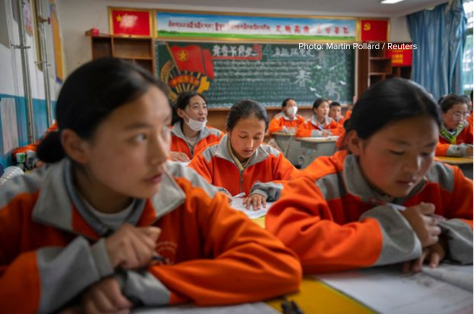 Classroom in Tibet with both Chinese and Tibetan texts on the blackboard
China has announced that Tibetan will no longer be a core subject in the gaokao, the national university entrance exam, starting in 2026. This far-reaching education reform means that only students specialising in Tibetan literature will still be able to take a Tibetan language exam — a fraction of all Tibetan students in the region.
Official Announcement Without Written Documentation
Gama Cedain, chairman of the government of the Tibet Autonomous Region and deputy party secretary, announced the change during a press conference in Beijing. Notably, the changes have been communicated verbally to teachers and students over recent months, without formal written announcements.
According to Gama Cedain, Tibet will, “just like other provinces and regions,” adopt uniform exam subjects such as Chinese, mathematics and foreign languages including English, Russian, Japanese, French, German and Spanish. Tibetan will disappear as a core subject from the exam.
Direct Consequences for the Job Market and Social Standing
Dawa Tsering, director of the Tibet Policy Institute in Dharamshala, warns of far-reaching consequences: “Once Tibetan is no longer part of the entrance exam, the language loses its legal and practical value in education and on the job market.”
The gaokao determines which university students can attend in China and thereby their future career opportunities. By removing Tibetan from this crucial exam, the economic value of mastering one’s mother tongue is drastically reduced for Tibetan youth.
Part of Systematic Sinicisation
This measure fits within President Xi Jinping’s broader sinicisation policy that has been explicitly aimed at “ethnic mingling” and “cultural identification” with the Han Chinese majority culture since 2014. Xi’s government set the ambitious goal in 2021 that 85 percent of China’s population should speak Mandarin by 2025.
UN human rights experts raised the alarm in February 2023 about the separation of approximately one million Tibetan children from their families for placement in state-run boarding schools. According to the experts, this boarding school system functions as a compulsory large-scale programme to assimilate Tibetans into the Han Chinese majority culture.
Closure of Tibetan Schools Accelerates
Parallel to the exam reform, China has forcibly closed numerous private schools and monastery-based primary schools specialising in Tibetan language education since 2021. In July 2024 alone, 69 primary schools were completely closed in Ngaba Prefecture, 8 schools were merged and 33 schools were forced to adapt their education systems.
That same month, 1,600 young monks from Kirti monasteries had to enrol in state-run boarding schools where education is conducted almost exclusively in Mandarin. Tibet Action Institute documented that 78 percent of Tibetan students between the ages of 6 and 18 are separated from their families in these colonial boarding schools.
International Concern Grows
US Secretary of State Antony Blinken announced visa restrictions in August 2023 for Chinese government officials involved in forced assimilation. The European Parliament demanded an end to China’s coercive school system in Tibet, while 15 countries condemned China’s separation of Tibetan children during the UN General Assembly.
Gama Cedain defends the reforms with the argument that they “offer students of all ethnic groups fairer access to quality education” and “improve the learning ability of minority students.” This official justification stands in stark contrast to the reality in which Tibetan children are being stripped of their mother tongue, culture and religious traditions.
The removal of Tibetan from the gaokao marks a critical moment in what international observers increasingly describe as a systematic attempt at cultural erasure. With this education reform, the Tibetan language loses not only its educational status but also its economic relevance, fundamentally threatening its transmission to future generations.
Sources
- China schrapt Tibetaans als hoofdvak uit toelatingsexamen
- China to Restrict Tibetan Language in Region's College Entrance Exam
- UN experts alarmed by separation of 1 million Tibetan children
- China excludes Tibetan from national college entrance exam
- How China Is Weaponizing Education to Erase Tibetan Identity