China celebrates 'Serfs' Emancipation Day' as commemoration of ending its autonomy promise to Tibet
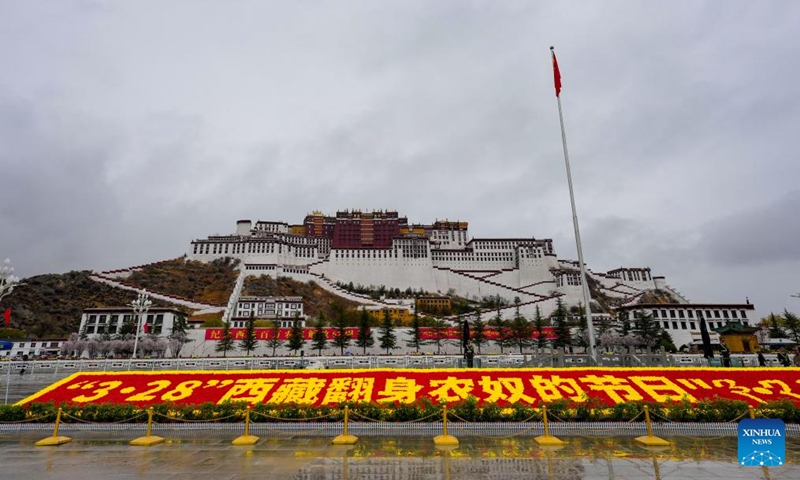 The Potala Palace in Lhasa framed by Chinese propaganda displays for the ‘3·28 Serfs’ Emancipation Day’, 28 March 2026. (Photo: Xinhua)
On 28 March 2026, China commemorated for the 67th time what it officially calls “Serfs’ Emancipation Day.” With flag-raising ceremonies at Potala Palace Square in Lhasa, cultural performances, and online propaganda campaigns, Beijing again presented the day as a celebration of liberation. Critics and the Tibetan government in exile, however, view it as a commemoration of the day China broke its promise of autonomy to Tibet.
The 1951 promise and the 1959 breach
In 1951, China signed the Seventeen-Point Agreement with Tibet, an arrangement with the character of a “one country, two systems” framework: Tibet would retain its existing system of government and social structure. That promise lasted eight years. On 28 March 1959 — in the wake of the major Tibetan uprising of 10 March — Premier Zhou Enlai dissolved the “local” Tibetan government by decree and replaced it with a Preparatory Committee for the Tibet Autonomous Region. In a single stroke, China ended what it had promised Tibet.
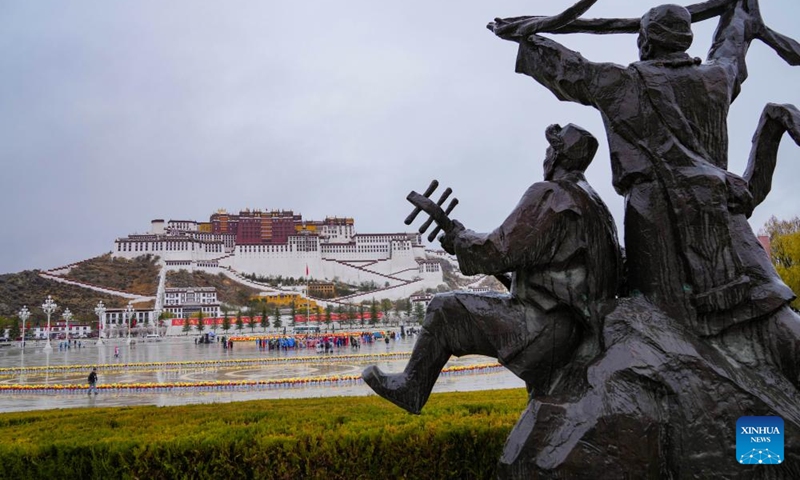 A bronze monument in front of the Potala Palace symbolising the Chinese narrative of the 1959 ‘liberation’. Chinese propaganda billboards are visible in the background. (Photo: Xinhua)
In 2009, in the aftermath of the large-scale Tibetan protests of March 2008, China’s National People’s Congress officially designated 28 March as a national holiday. The date was also designed as a direct counterpoint to 10 March — the day Tibetans worldwide mark as the anniversary of the Tibetan National Uprising.
Official celebrations in 2026
TAR Chairman Karma Tsetan delivered a televised speech on the evening of 27 March to mark “the 67th anniversary of the emancipation of a million serfs.” Chinese state media described the 1959 reforms as the definitive end of a “dark, cruel, barbaric, and backward theocratic feudal serfdom.” At the Potala Palace Square, Chinese flags were raised and state-organised Tibetan cultural performances were staged.
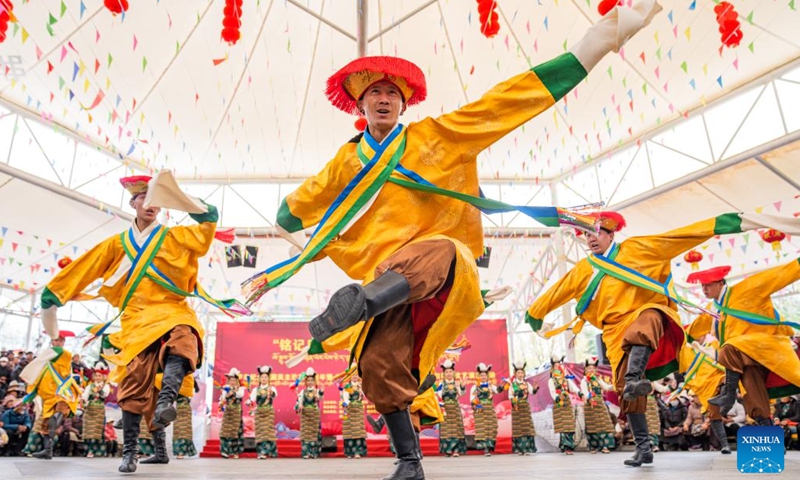 State-organised cultural performances during the ‘Serfs’ Emancipation Day’ celebrations in Lhasa, 28 March 2026. (Photo: Xinhua)
A different reading of history
The Central Tibetan Administration (CTA), Tibet’s government in exile, fundamentally contests the Chinese historical narrative. According to the CTA, Chinese rule has resulted in the death or unnatural death of more than 1.2 million Tibetans, the destruction of over 6,200 religious sites, and irreversible damage to the fragile ecology of the Tibetan plateau.
What China calls a “liberation,” Tibetans regard as the beginning of an occupation. Within Tibet, “Serfs’ Emancipation Day” is not experienced as a holiday but as a state-imposed propaganda day. The date marks in Tibetan memory the moment when the Dalai Lama was forced into exile and Tibet lost its last remnant of administrative self-governance.
Propaganda as a political instrument
The establishment of the holiday in 2009 had a clear political purpose: to neutralise international attention on 10 March. By creating its own commemorative day, Beijing can set the agenda, canonise the Chinese reading of Tibetan history, and frame any criticism as interference in “internal affairs.”
The 2026 celebrations took place against the backdrop of China’s recently adopted Law on Promoting Ethnic Unity and Progress — a law critics regard as a further codification of the assimilation policy whose starting point were the “reforms” of 1959.
Sources
- China celebrates Serfs' Emancipation Day to mark terminating one country, two systems policy for Tibet
- Serfs' Emancipation Day; a Chinese drama to mislead the international community
- China celebrates 65th anniversary of its trashing of one country, two systems policy for Tibet
- Serfs' Emancipation Day marked in Lhasa, China's Xizang
- Truth about China's Serfs Emancipation Day: Demand for end to brutal occupation of Tibet gains global momentum