Time to break the silence: Experts call for recognition of Tibet's illegal occupation
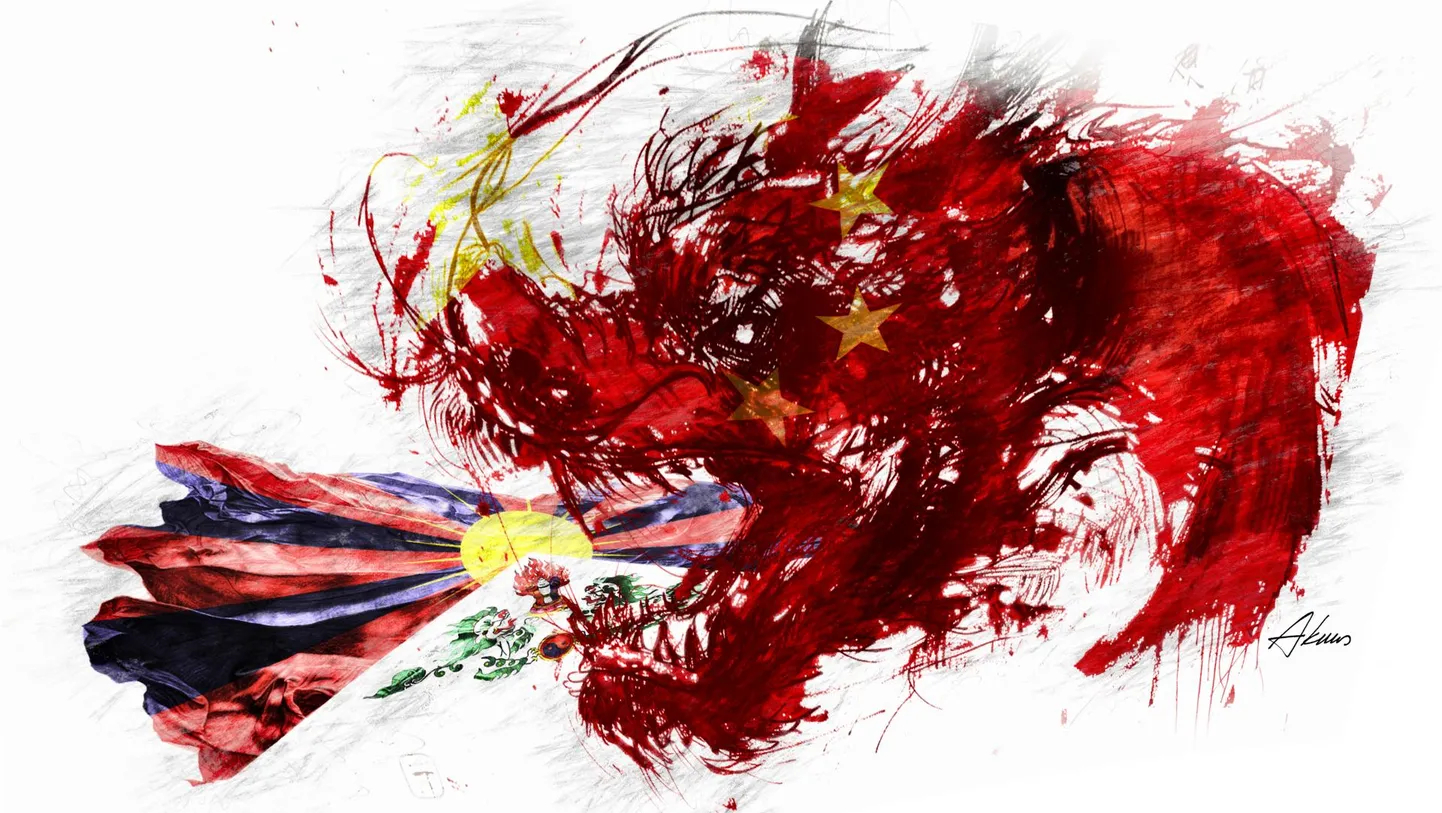 Illustration of China’s dragon trying to swallow the Tibetan flag
In a powerful plea published in the Estonian daily Postimees, conflict resolution expert Miek Boltjes and international jurist Michael van Walt van Praag call on the international community to finally face the truth about Tibet. After more than seventy years of Chinese occupation, it is time to break the silence and stop accepting Beijing’s illegal annexation of Tibet.
A fabricated historical narrative
The experts reveal how China’s claim to Tibet rests on a completely fabricated historical narrative. “There was no continuous Chinese state before 1912,” the authors state. The concept of an ancient “Chinese Empire” encompassing Tibet is a modern construction with no legal or historical basis whatsoever.
The current regime in Beijing bases its territorial claims on a mythical version of the past, in which diverse empires and dynasties — often led by non-Chinese rulers such as the Mongols and Manchus — are retroactively reinterpreted as “Chinese” entities. This historical falsification serves one purpose: to legitimize what is in reality a violent annexation.
From self-censorship to complicity
What the article exposes most painfully is how Western governments have allowed themselves to be lured into self-censorship. Out of fear of Chinese economic reprisals, they treat Tibet as an “internal Chinese affair” — exactly the narrative Beijing wants to impose.
“China has grown into a privileged bully,” the authors write, “pursuing territorial expansion while the world watches.” These harsh words underscore an uncomfortable truth: by remaining silent about Tibet, democratic nations are making themselves complicit in the oppression of the Tibetan people.
The 1950 invasion: A forgotten aggression
 The Chinese People’s Liberation Army invades Tibet in 1950 — an act of aggression that has never been acknowledged
The authors remind us of the facts that are often ignored: in 1950, the Chinese People’s Liberation Army invaded independent Tibet. This unprovoked invasion of a peaceful Buddhist country was followed by systematic repression, cultural genocide, and the flight of the Dalai Lama in 1959.
 The Tibetan uprising of March 10, 1959 — a desperate attempt at resistance against the Chinese occupation
Since then, China has pursued a policy of colonization, whereby ethnic Tibetans have become a minority in their own capital, Lhasa. Tibetan language and culture are systematically suppressed, monasteries destroyed or placed under strict supervision, and every form of dissidence is ruthlessly punished.
A call to action
Boltjes and Van Walt van Praag make concrete recommendations to the international community:
- Treat the Sino-Tibetan conflict as an international issue, not as an internal Chinese affair
- Actively challenge China’s historical narrative with facts and legal arguments
- Refuse to recognize the illegal annexation of Tibet, just as the world does not recognize the Russian annexation of Crimea
- Support the right to self-determination of the Tibetan people
The Netherlands’ responsibility
For the Netherlands, this call has particular significance. As a country that presents itself as a champion of international law and human rights, the Netherlands can no longer look the other way. It is time for Dutch politicians and policymakers to show the courage to refute Beijing’s lies and stand up for the Tibetan people’s right to self-determination.
The authors warn that silence on Tibet not only harms the Tibetan people but also undermines the international legal system. If aggressor states can count on accommodation rather than resistance, then violence is rewarded and peaceful peoples become the victims.
A moral urgency
 The Dalai Lama continues to advocate for nonviolent resistance and dialogue, despite decades of Chinese repression
The article by Boltjes and Van Walt van Praag is more than an academic analysis — it is a moral wake-up call. After more than seventy years, it is time to stop appeasing Beijing. The Tibetan people deserve solidarity, not silence. Their struggle for freedom and self-determination deserves recognition, not denial.
As the authors conclude: “It is time to break the silence.” For everyone who believes in justice, human rights, and the dignity of all peoples, this is a call that can no longer be ignored. Tibet must not be forgotten. The truth about China’s illegal occupation must be told, again and again, until justice prevails.
Support Tibet
This important article underscores why the Tibet Support Group Netherlands continues to fight for awareness and action. Every voice counts in breaking the silence that Beijing so desperately wants to maintain. Inform yourself, share this knowledge, and support the Tibetan cause. Because as this article makes clear: silence is complicity, and it is time to speak.